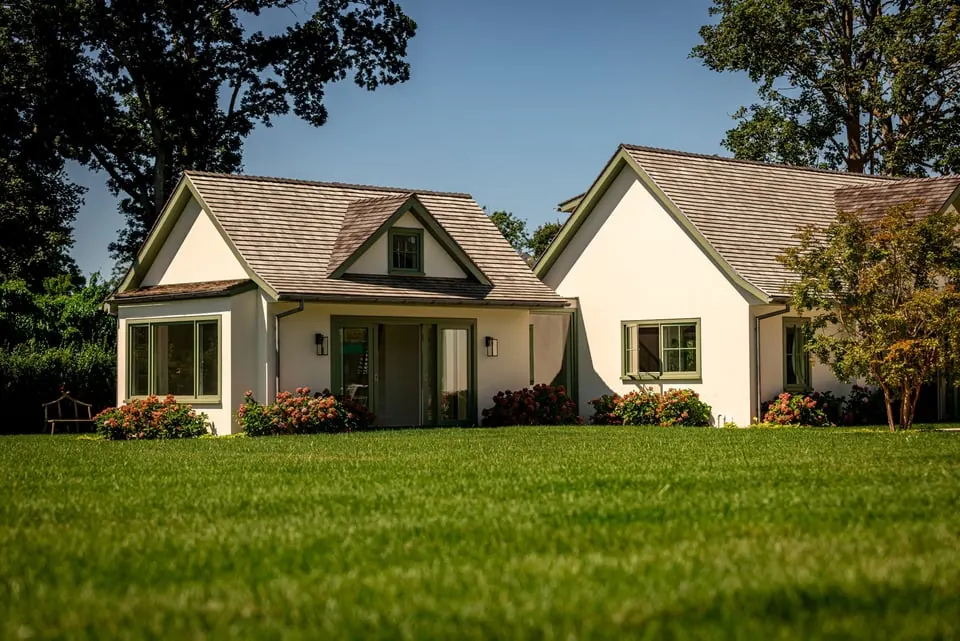
Most Hamptons garden design is built for eleven weeks of the year. Everything peaks around the Fourth of July, holds through August, and then quietly falls apart the week after Labor Day, right as the light turns gold and the place becomes genuinely pleasant to be in.
If you are here in October, or in February, or you simply want the view from the kitchen window to be worth looking at in November, the design brief has to change. Not the plants so much as the thinking behind them.
Peak summer flatters bad design. Everything is in leaf, the annuals are doing their job, and the borders are full enough to hide the fact that there is no underlying structure. Take the foliage away and you find out what was actually there.
What is usually there is a collection of good plants with no relationship to each other. That works in July because abundance covers the gaps. It fails in November because the gaps are all that is left.
The gardens that hold up out here share one thing: they were designed as a composition first and planted second. The perennials are the last decision, not the first.
Structure is what remains when the growing season ends, and it does three jobs at once.
It defines the space. A garden without edges reads as an accident. Clipped hedging, a stone wall, a mown line against a looser planting: any of these tell the eye where the garden begins and ends. On an East End property with a lot of sky and horizon, that definition matters more than it would inland.
It carries the winter. Evergreen mass, whether hedging, holly, inkberry or red cedar, holds the picture together from November through April. A garden with no evergreen backbone spends five months looking like a construction site with mulch.
It gives the loose planting permission to be loose. This is the trick most people miss. Grasses and perennials look wild when they are floating in space and intentional when they are held inside a defined frame. The frame does the work. The planting gets the credit.
Bed geometry is part of this. Long, generous, simple shapes read as designed. Fussy curves and narrow strips read as leftover space around a lawn, which is usually exactly what they are.
Once the structure holds, the planting can do something more interesting than bloom.
Grasses are the most underused asset out here. Little bluestem turns bronze and stays standing all winter. Switchgrass catches low light in a way nothing else does. Both handle salt, wind and sandy soil without complaint, and both look better in December than they do in June. Leave them up until March.
Seed heads and stems count as interest. Cutting everything back in October is a habit inherited from a different climate. Hydrangea heads, sedum, coneflower, grasses: they hold structure, catch frost, and feed birds. Cut back in late winter instead and you gain a whole season.
Bark and berry earn their keep. Winterberry against snow. Serviceberry bark. Red twig dogwood. These read from a distance in a season when nothing else does.
Late bloomers extend the good part. New England aster and seaside goldenrod hit their stride in late September, exactly when the summer borders are exhausted and the weather is at its best.
The plants that thrive here also happen to be the ones already adapted to salt air and fast-draining soil, which is why native and salt-tolerant planting tends to underpin the gardens that need the least intervention.
A large property raises a question a small one does not: where should the garden actually be?
The instinct is to spread planting evenly across the site. It rarely works. Perennial gardens need proximity to be enjoyed and maintenance to stay sharp, so the honest answer is to concentrate them where people actually stand.
That usually means the approach to the house, the terrace or pool surround, and the view from whichever room gets used most. Everything beyond that can transition into meadow, mown grass, or massed shrub planting that carries the property without demanding weekly attention.
This is not a compromise. A tightly composed perennial garden near the house, framed by simpler planting as the property opens out, reads as far more considered than the same investment scattered thinly across two acres.
For anyone who has not done this before, the sequence tends to be the useful part.
Site analysis comes first. Sun and shade through the day, prevailing wind, salt exposure, drainage patterns, existing trees worth building around, soil. Skipping this is how properties end up with a decade of plant replacement.
Then the concept. How the space is organized, where the structure sits, how someone moves through it, what gets seen from where. This is the stage that determines whether the garden works, and it happens before a single plant is named.
Then drawings. Plans and, increasingly, 3D renderings, which are worth the effort because most people cannot read a plan view and are being asked to approve something expensive.
Then planting design. Species, quantities, sizes, placement. Drifts rather than singletons. Repetition to hold it together.
Then permitting, where required. Village review, wetlands, anything near a bluff or a pool. This step is longer than people expect on the South Fork, and it is easier to plan around than to discover.
Then installation, and then the first three years. A garden is not finished on install day. It is finished around year three, when the planting knits together and the structure has filled in.
A Hamptons garden designed only for August is a seasonal rental of your own property. A garden with real structure, a four-season palette and planting concentrated where you actually stand gives you something that holds up in February, looks composed from the kitchen window in November, and still does everything you wanted in July.
It costs roughly the same. It just requires deciding the hard things first.
If your beds are working for two months and disappointing for ten, that is a design question rather than a plant question. A consultation and a walk of the property is usually enough to see what is missing, and the design process takes it from there.
